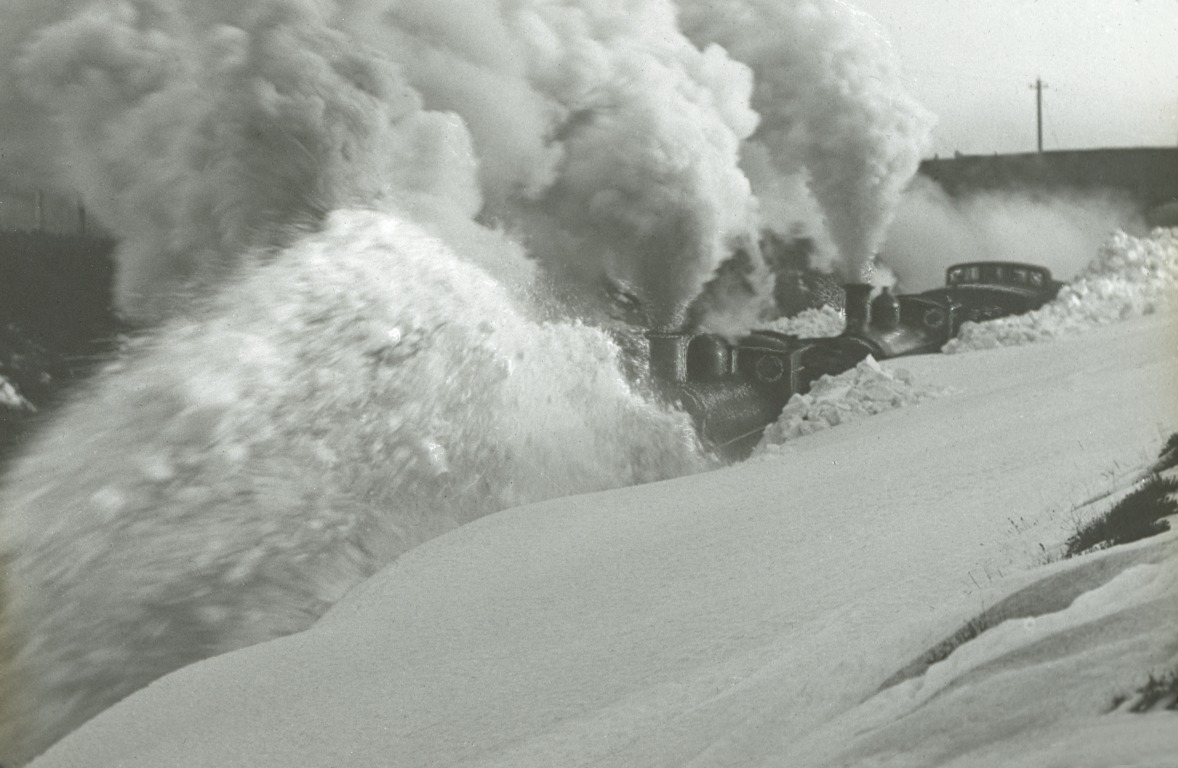
Winters past on the Far North Line could bring extraordinary challenges. Across the exposed landscapes of Sutherland and Caithness, deep drifting snow could bury the tracks, leaving railway workers battling to keep trains moving with snow fences, railway snow ploughs and, when machinery could do no more, shovels.Today, remarkable archive photographs capture steam locomotives charging into snowdrifts, railway workers digging out buried tracks by hand and the sheer scale of winter conditions once experienced on the Far North Line in Scotland.
Alongside those photographs are the memories of people who experienced these winters themselves. One particularly remarkable first-hand account comes from passenger Andy Anderson, whose journey north during the snowstorm of January 1978 became one he would never forget.
Why Was Snow Such a Challenge on the Far North Line?
The Far North Line passes through some particularly exposed country on its journey north through Sutherland and Caithness to Wick and Thurso.
The railway across the Flow Country, including the section around Forsinard, Scotscalder and Altnabreac, was particularly susceptible to drifting snow. Strong winds sweeping across the open landscape could carry snow onto the railway, where it accumulated into substantial drifts.
Historical accounts sometimes refer to a “snow wreath”, a Scots term for a bank or drift of snow. On the railway, these snow wreaths could become formidable obstacles.
During the second half of the 19th century, when the railway was still relatively new, engineers had to find ways of preventing these drifts from blocking the line.
Keeping the Highland Railway Open in Winter
One of the first lines of defence against drifting snow was the humble snow fence.
Fences, sometimes constructed using old railway sleepers, were erected beside vulnerable stretches of track. During particularly severe conditions, however, they could not always cope with the volume of snow being blown across the railway.
A rather more ingenious solution was eventually introduced.
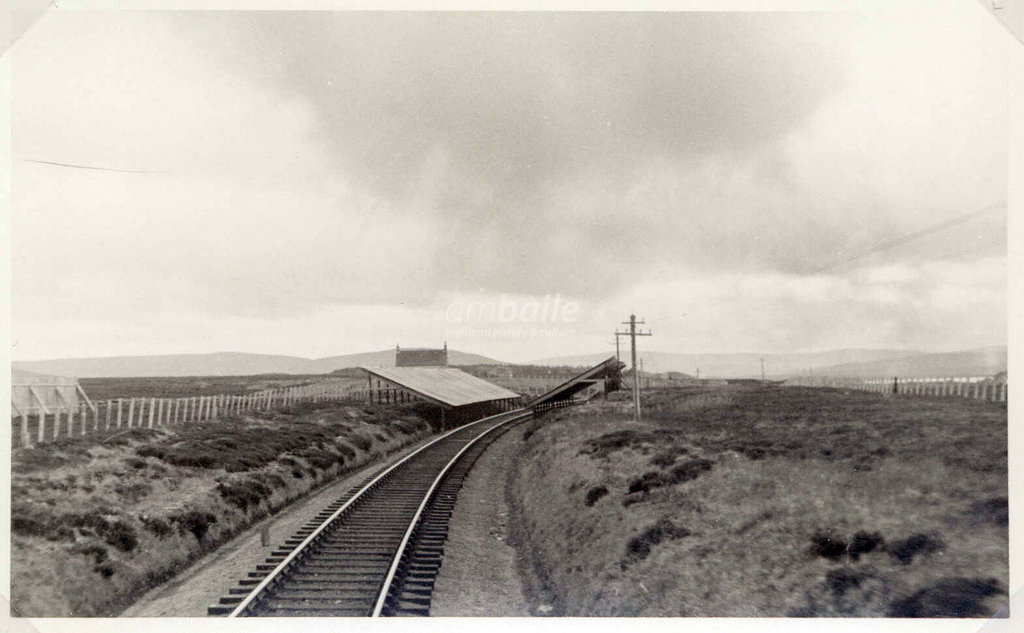
Known as “blowers”, these were specially designed close-boarded wooden structures positioned alongside the railway.
Railway historian H. A. Vallance described them in The Highland Railway as resembling long wooden tables. Their inner edges were positioned close to the ground beside the track, while their outer edges were raised around eight to ten feet.
Rather than simply stopping the snow, the structures altered the movement of the wind. Air currents were deflected away from the railway, helping the snow to be carried over the track and deposited on the other side.
Examples of these unusual structures could still be seen near Forsinard in the 1950s.
Railway Snow Ploughs Take on the Drifts
When attempts to prevent drifting snow failed, the Highland Railway needed something considerably more powerful.
During the 1860s, railway snow ploughs were designed and built at the Lochgorm Works in Inverness. The Highland Railway had three different sizes of snow plough for tackling blockages, reportedly capable of shifting snowdrifts reaching up to 12 feet deep.
The method used to attack a particularly large drift sounds dramatic even today.
As many as four locomotives could be coupled together behind a snow plough. The engines would build up momentum before the plough charged into the snowdrift, sometimes beginning its run from around half a mile away.
The ploughs were also fitted with hinged side flaps which could be folded up when not in use.
But even this combination of engineering and steam power could not always defeat a Highland winter.
Sometimes there was only one solution.
The railway had to be dug out by hand.
The Great Snowstorm of 1906
Some of the most striking photographs illustrating winters past on the Far North Line date from the great snowstorm of 1906.
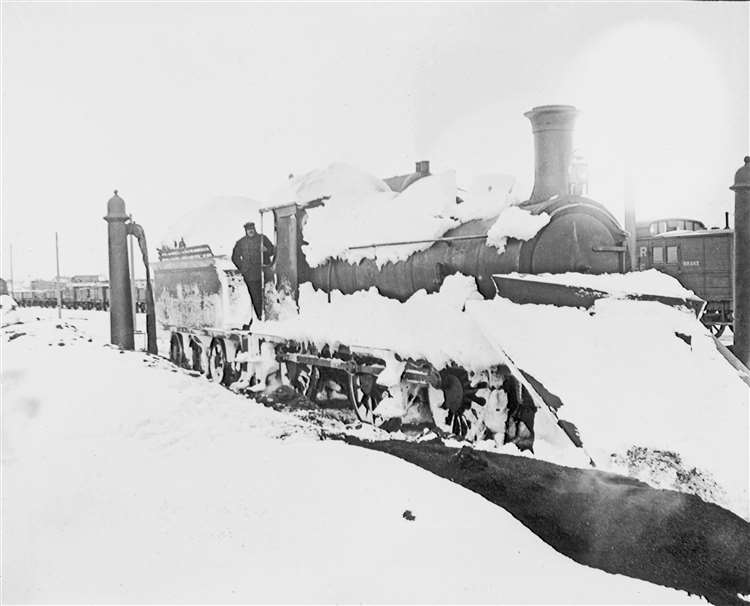
One remarkable image shows a Highland Railway “Barney” 0-6-0 locomotive fitted with a snow plough at Helmsdale, almost disappearing beneath the snow.
Even though the locomotive had been in steam, snow remained piled across its boiler and running gear, a striking indication of the conditions in which the railway was operating.
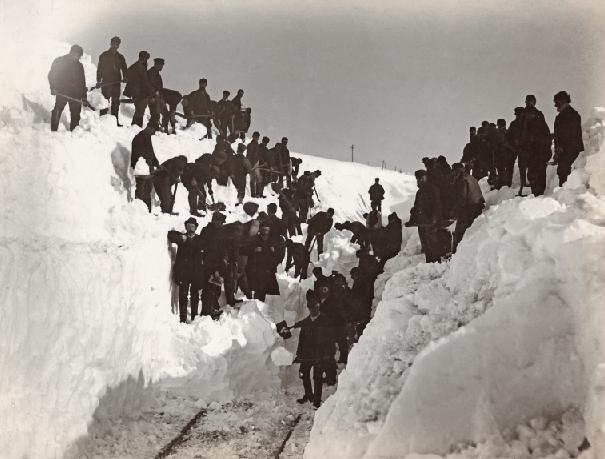
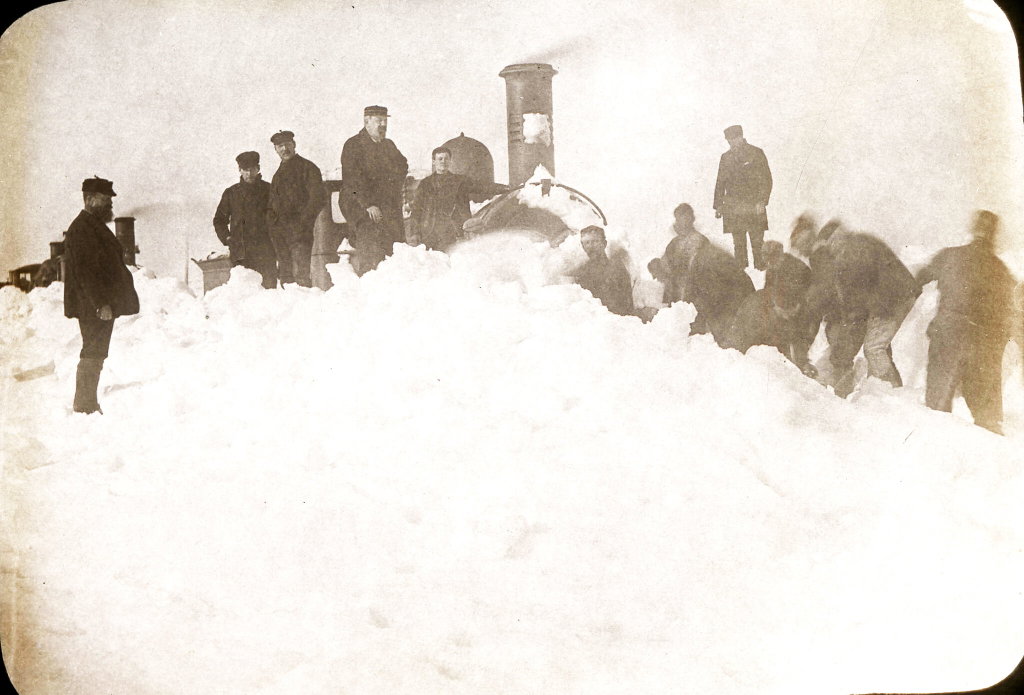
Other surviving photographs show railway workers physically digging the railway out.
These images give an even more vivid impression of the scale of the task. This was not simply a matter of clearing a few inches of snow from the rails. In places, workers were faced with substantial walls of compacted and drifting snow that had to be removed before trains could continue.
Photographs from the severe winter of February 1895 show just how formidable the task could become, with large gangs of railway workers digging through deep banks of snow to reopen the line.
The Snowstorm of January 1978: A Passenger’s Story
In January 1978, passenger Andy Anderson set out on a journey north that would become another extraordinary chapter in the story of winters past on the Far North Line.
After first becoming stranded by road near Navidale, Andy returned to Helmsdale and boarded the train north at around 10 pm. What followed included a derailment, another encounter with a deep snowdrift near Altnabreac and, eventually, a rescue involving helicopters.
Here is Andy Anderson’s personal account of the experience, reproduced in full with permission.
The Snow Storm, January 1978
A personal account by passenger Andy Anderson
“We stayed overnight with our friends in Inverurie, and setting out by car behind the snowplough, made our way through snow, slush and rain arriving at Helmsdale in late afternoon. By this time road conditions were deteriorating and we were eventually stuck in a deep drift just after Navidale. The car was abandoned and a lift back to the hotel at Helmsdale was offered and accepted with thanks.
Although there was a power cut, the hotel was buzzing and the atmosphere was tremendous with open coal fires in every room and an abundance of hot soup, sandwiches and other food readily available.
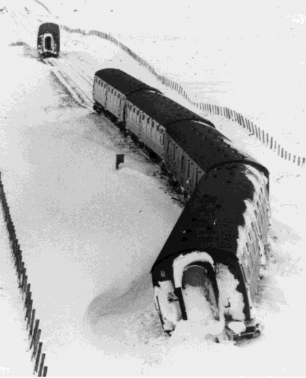
However the train north was still running, consisting of two diesel engines pulling five of the old fashioned type of compartment coaches. It departed Helmsdale at about 10 pm amidst heavy snow showers and in the teeth of a gale. There was a great deal of noise, the carriages were buffeted about and luggage was tumbling out of the racks. It was particularly bad in the third coach as we went through to join the Wick section. Suddenly there was a horrendous crash and the train came to a juddering halt. Later we found that the third coach had been derailed and the wheels had been running on the sleepers for over a mile when the coupling between the second and third coaches had sheared, together with the air brake pipes. The two parts of the train finished over 100 yards apart.
The train staff were excellent and transferred around 70 passengers under difficult conditions to the front coaches where they were ‘crammed in.’ My memory of that time was of the telephone wires encased in six inch coating of ice, coming straight down the pole, along the ground and up the next pole.
Eventually we were underway and everything went fine until a deep snowdrift brought us to a halt near Altnabreac. There arose some concern among the passengers because no one outside the train realised where it was or what had happened; the possibility of a long uncomfortable wait was inevitable. Those with food shared with those who had not and then all tried to settle down until help arrived. One engine was kept running to provide some heat but gradually the temperature went down. As daylight arrived Lochdhu Lodge appeared between the showers like a submarine on a vast frozen seascape.
In the afternoon several railwaymen appeared with, I believe, two tins of soup and a pint of milk. This was all mixed together, heated at the engine exhaust, and distributed in minute amounts to the passengers. The railwaymen explained that they had set out on an engine on a single line to meet an oncoming passenger train in zero visibility without knowing where it was — probably the first and last time such an order was given. Fortunately, this train stuck in a snowdrift and they walked along the line to meet us.
At about 3 pm a large helicopter arrived to take photographs for a national newspaper and to deliver warm food and sleeping bags for the next night. After discussion they uplifted the women passengers and an old man with his dog and delivered them to Wick airport.
Shortly afterwards, we thought our troubles were over when a small yellow rescue helicopter landed and informed us that he would ferry us three at a time to the nearest house with a road. On arrival at Scotscalder we were told the telephone was out of action and the road was blocked. When the remainder of the group arrived we walked through deep snow across the fields to the railway line and into Halkirk. My abiding memory is of being taken in to a railwayman’s home and the smell coming from the huge pot of homemade soup bubbling away on the stove — the taste to cold hungry folk was out of this world. The rail staff were very kind, helpful and extremely professional throughout the incident.
Because of this, emergency rations were always carried in the guard’s van on the north lines until the advent of the tea-trolley made this unnecessary.”
Remembering Winters Past on the Far North Line
Andy Anderson’s account brings to life something that photographs alone cannot quite capture: what it actually felt like to travel through one of these extraordinary Highland winters.
His memories also echo something visible in photographs taken many decades earlier during the Highland Railway era: the importance of the people who kept the railway going.
From steam crews driving railway snow ploughs into towering drifts to gangs of railway workers digging out the track by hand, keeping trains moving through severe winter weather could require ingenuity, determination and considerable physical effort.
Yet the photographs and first-hand recollections remain.
Together, they preserve an extraordinary chapter in the history of the Far North Line: winters when snow could transform the railway through Sutherland and Caithness into a landscape of deep drifts, buried tracks and locomotives battling their way north.
They also preserve the stories of the railway workers, passengers and local people who experienced those winters past on the Far North Line.
Sources and Acknowledgements
With thanks to Andy Anderson for permission to reproduce his personal account of the January 1978 snowstorm.
Historical information used in this article has been drawn from archive material and accounts relating to the Highland Railway and Far North Line, including material from the Highland Railway Society, Am Baile, National Railway Museum and other credited archive sources.